Game On: How XWORLD is Pioneering the Web3 Revolution through Entertainment, Gaming, and Finance
Discover the Power of Play: Unleashing the Future of Digital Interaction with XWORLD
The digital frontier is witnessing a seismic transformation with the advent of Web3, a decentralized version of the internet, promising to reshape our digital experiences. At the vanguard of this revolution is XWORLD, a new-gen gaming and app monetization platform. By seamlessly integrating elements of entertainment, gaming, and finance, XWORLD is pushing the boundaries of what’s possible in the Web3 space.
Imagine an online world where gaming transcends the traditional boundaries of play. Where your passion for entertainment can be seamlessly intertwined with the potential for financial reward. This is the world XWORLD is creating.
By leveraging the power of Web3, XWORLD introduces a new paradigm in the gaming industry — Use to Earn. This innovative model transforms gaming from a simple recreational activity into a potentially lucrative endeavor. It empowers players to earn real-world value from their in-game achievements, turning every game into an opportunity.
But XWORLD’s revolutionary approach goes beyond gaming. By integrating financial elements into its platform, XWORLD creates a unique ecosystem where users can monetize their digital experiences. This fusion of gaming and finance brings about a new era in digital interaction, where every action has the potential for profit.
XWORLD’s merging of entertainment, gaming, and finance also serves to democratize the digital space. Through its decentralized platform, every user becomes a stakeholder, with their contributions directly impacting the platform’s economy. This level of user empowerment is a defining feature of Web3 and a testament to XWORLD’s commitment to this revolutionary technology.
This innovative approach is not just reshaping the landscape of digital entertainment and gaming; it’s also fueling the growth of Web3. As more and more users are drawn to platforms like XWORLD, the adoption of Web3 technologies is accelerating. This influx of users is a clear indication of the impending expansion of the Web3 space.
Yet, XWORLD is more than just a platform; it’s a community. A place where gamers, developers, and enthusiasts can come together to connect, collaborate, and create. It’s a breeding ground for innovation, pushing the boundaries of what’s possible in the digital world.
As we stand on the brink of a new digital era, XWORLD is leading the charge. With its innovative approach and commitment to Web3 principles, it’s set to redefine the way we interact with the digital world.
So, are you ready to be part of this revolution? Are you ready to embrace the power of play, to tap into the potential of digital monetization? If the answer is yes, then it’s time to join the XWORLD community.
To stay updated on all things XWORLD and to be part of this exciting journey, follow XWORLD on Twitter at https://twitter.com/xworld_pro. Be part of the change as we usher in a new age of internet usage, gaming, and digital monetization. Welcome to XWORLD, the platform that’s powering the Web3 revolution.
XWORLD
New-Gen Games & Apps Monetization Platform
Website | Twitter | Instagram | Facebook |Litepaper
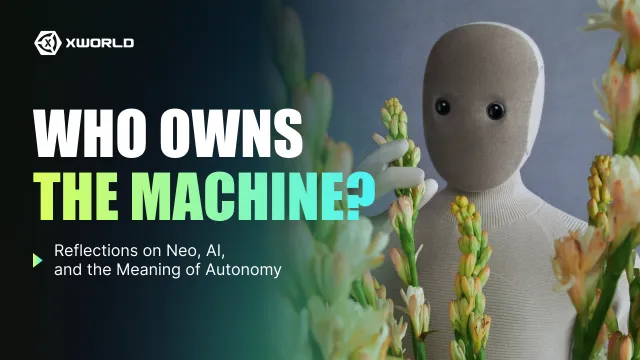
Who Owns the Machine? Reflections on Neo, AI, and the Meaning of Autonomy
At the end of October 2025, 1X Technologies' humanoid robot Neo swept through the tech world like a heatwave. This sleek robot, backed by OpenAI, is touted as the first truly home-friendly physical assistant.
Priced at around $20,000 or $499 per month for leasing, Neo can clean, carry items, and even learn new tasks through imitation. In just a few days, it became the internet's focal point — seemingly, a tireless family companion has finally arrived.
Yet, behind the cheers, a profound reflection on "autonomy" quietly unfolds. Remote control offers the illusion of convenience, but it exposes a core pain point in the AI industry: human operators still lurk in the shadows, and what happens to your privacy data?
As Curious CEO David Tomasian puts it:
"True autonomy is the only way machines can belong to us."
An Illusion: The Myth of Humanoid Robot "Autonomy"
Neo's launch is indeed exhilarating: standing 5 feet 6 inches tall and weighing 66 pounds, it uses tendon-driven actuators mimicking human muscles, wrapped in a soft shell for safety. Hugging Face co-founder Thomas Wolf exclaimed on X that Neo has "advanced" his timeline for home robot adoption.
In demos, Neo waters plants, opens doors, washes clothes, and scrubs dishes, turning mundane chores into something poetic and efficient.
But this excitement was quickly doused by reality. The Wall Street Journal's hands-on report reveals that many of Neo's movements are still remotely controlled in real time by "experts" via VR.
This isn't sci-fi — it's the current state of AI, where remote piloting aids companies in training models through imitation and reinforcement learning, yet reduces the robot from "independent helper" to "human extension."
Tomasian sharply notes that under this model, your "private robot" isn't truly private: it not only observes your life but uploads data to the cloud, fueling the manufacturer's training.
When a robot can "see" your home layout, recognize your voice, and analyze your habits — yet remains tethered to the manufacturer's servers — who does it really belong to?
From Factory to Home: The Privacy Cost Beneath Autonomy
The wave of humanoid robots is flowing from factories to living rooms. Figure AI's Figure 02 and Tesla's Optimus aim to reshape industry, while Neo pushes the vision into consumer territory — not just productivity, but companionship itself.
This trend is especially urgent in elderly care. Pilot projects in Japan, Korea, and parts of Europe are testing robots for assisting daily activities, monitoring health, and providing emotional support. But Tomasian points out: "The difference between aid and true care lies in understanding context and emotion." If data isn't encrypted and stored locally, "the robot isn't yours—it's someone else's lens."
Privacy expert Kohei Kurihara disclosed on X that Neo users must sign a waiver allowing manufacturers access to certain operational data. This "tech-for-convenience" pact hides cracks in trust. A Medium article bluntly states that this $20,000 robot "needs a human babysitter", with complex tasks requiring an appointment for "expert mode," making users feel like they're renting a "surveilled puppet."
Tomasian emphasizes that for embodied intelligence to evolve like language models, three things are essential: on-device reasoning, multimodal understanding, and encrypted autonomy. AI must not just execute commands but comprehend "why" they are given, ensuring data sovereignty belongs to the user. True care reliability stems from security and privacy, not algorithmic complexity. In other words, autonomy isn't just a technical issue — it's a social contract: Machines should embody trust, not extend surveillance.
From Embodied to Digital: AI Agents' Lessons on Autonomy
Neo's controversy reflects a deeper trend: "Autonomy" isn't confined to mechanical limbs — it's also about digital intelligence. Rather than teaching robots in your living room how to wash dishes, why not have agents on the network learn to "act on your behalf"?
AI Agents are the extension of this direction. They're not humanoid replicas but digital extensions of human will — capable of executing tasks, making decisions, and completing transactions on behalf of users, with data ownership retained by the individual.
IBM's "2025 AI Agent Report" states that Agentic AI promises an 8x productivity boost, hinging on autonomous reasoning combined with privacy protection.
Google Cloud research shows 52% of enterprises using generative AI have deployed AI Agents.
Deloitte predicts half of companies will enable Agentic AI by 2027.
Gartner forecasts that within four years, agents will autonomously handle 15% of daily decisions.
This shift redefines "autonomy": no longer machines mimicking human limbs, but agents learning to represent human intent.
XWorld: A Real-World Experiment in "Machines Belonging to People"
Amid this trend, the XWorld platform's explorations stand out. Since its 2023 launch, it has built a self-sustaining "agent economy" by combining AI training with token incentives: users can create, deploy, and monetize their own AI Agents. The integration of stablecoins makes settlements lower-friction, ensuring value flows under user control.
Today, XWorld boasts over 11 million downloads and 1 million monthly actives in its Telegram MiniApp ecosystem, with cumulative token trading volume exceeding $34.7 million.
Here, autonomy is no illusion — it's a reality co-built by users, developers, and agents: machines not only execute instructions but become "intelligence we own."
Epilogue: Who Truly Owns the Machines?
Neo reminds us: when "autonomy" becomes a selling point, oversight and trust must evolve in tandem.
The future shown by the AI Agent industry offers another possibility:
Machines are no longer just used, but truly "owned";
They no longer serve the network, but human will and data sovereignty.
XWorld's experiment may provide the answer: when "agent autonomy" merges with "user ownership," machines finally begin to belong to us.
In the future, when robots no longer need human eyes, that may be humanity's true liberation.
🔗 Learn more and join XWorld
Website | Whitepaper | Twitter | Telegram | Youtube | Linktree
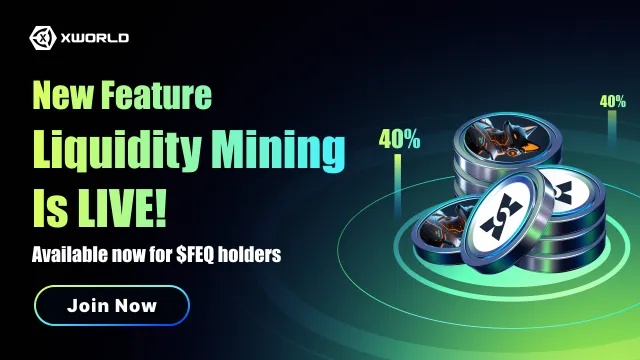
New Feature: Agent Liquidity Mining Is LIVE!
XWorld is excited to unveil Agent Liquidity Mining — a brand-new mechanism to reward long-term holders and strengthen the ecosystem!
🌊 What Is Liquidity Mining?
By pairing your Agent Token with an equal amount of $WORLD, you can add liquidity and enjoy multiple rewards:
🔹 Up to 40% Annualized Yield
Rewards grow with time — the longer you stay in, the higher the APR (up to 40% after 12 months).
🔹 Earn Transaction Fees
Earn a share of trading fees generated from the liquidity pool, based on your contribution ratio.
🔹 Flexible Management
Create, partially withdraw, or fully remove your liquidity at any time. Unclaimed rewards will be automatically collected when you withdraw.
💡 Reward Details
Annualized Yield (APR)
Distributed monthly on the 1st (UTC+0) in off-chain $WORLD.
Yield increases linearly each month, up to a maximum of 40% APR.
Transaction Fees
Can be claimed manually at any time (gas fees apply), or automatically upon full withdrawal.
📌 Who Can Join?
For the best user experience, liquidity mining is only available to AI Agents with a market cap ≥ $1.5M
Trying to join early? You'll see this message:
"To ensure optimal functionality, liquidity mining is only open to AI Agents with a market cap of 2M or higher".
🛠 Feature Highlights
Access the feature directly via your Agent Details Page
Create positions with just a few clicks
View total position value, real-time APR, and unclaimed rewards
Sort and manage multiple liquidity positions with ease
All actions (add/remove/claim) supported with secure on-chain confirmation
🧪 Why This Matters
This is a key step in our mission to:
✅ Encourage long-term holding
✅ Boost liquidity and token stability
✅ Reward our early believers and ecosystem contributors
Agent Liquidity Mining is a smart move to earn rewards while strengthening the ecosystem.
Let your Agent work smarter, join now and make the most of your $WORLD!
🔗 Learn more and join XWorld
Website | Whitepaper | MiniAPP | Twitter | Telegram | Linktree