Hamas-Israeli conflict triggered a rise in interest in crypto assets; Ferrari and Taylor Swift accept Bitcoin payments; Can AI interpret dreams come true? | XWORLD Daily
Israel attack could spark interest in gold, cryptocurrencies and safe-haven assets
The Israel-Hamas conflict is a long-running, deep-rooted dispute between Israel and the Palestinian Hamas group, primarily centered in the Gaza Strip.
The ongoing geopolitical conflicts in the Middle East, particularly between Israel and Hamas, have inadvertently highlighted some potential positive impacts on cryptocurrencies. First, rising geopolitical tensions may fuel interest in digital assets as safe-haven investments.
Cryptocurrencies like Bitcoin are increasingly viewed as “digital gold” due to their limited supply and decentralization, making them an attractive option for investors seeking refuge in uncertain times.
As traditional safe-haven assets such as gold and the U.S. dollar face challenges, cryptocurrencies may emerge as alternative stores of value.
Second, the conflict highlights the utility of cryptocurrencies in facilitating cross-border transactions and providing financial services to individuals affected by political unrest.
In regions with strict capital controls or unstable financial systems, cryptocurrencies can provide a means to preserve wealth and conduct international trade outside of the traditional banking system.
The conflict underscores the need for borderless and censorship-resistant financial instruments, reinforcing the role of cryptocurrencies in financial inclusion and resilience in areas of geopolitical tension.
The conflict in the Middle East indirectly demonstrates how cryptocurrencies can facilitate global investment and financial empowerment in crisis-affected regions.
SkyBridge Capital founder: The Federal Reserve system has fundamentally collapsed, and Bitcoin’s market value may reach $15 trillion
Anthony Scaramucci, founder of Skybridge Capital, said in an interview that although the Fed is performing well, the system in which the Fed operates is fundamentally broken. He cited concerns about the devaluation of fiat currencies and said the U.S. government was spending more than it was taking in.
He explained that this situation is dangerous because the borrowed money must be repaid with more dollars, which could lead to a severe economic recession. Therefore, he concluded that the Fed would eventually find itself in trouble due to a system breakdown.
As a solution, he proposed an alternative, an immutable asset with clear scarcity that is essentially a transparent transaction ledger. He pointed out that no asset has such characteristics except Bitcoin, which he believes is evolving into a store of value that may be more valuable than gold.
He predicted that in the event of a collapse of the U.S. financial system, Bitcoin’s market capitalization would reach $15 trillion.
Bloomberg TV to launch SBF documentary on October 26
Bloomberg Television will launch the documentary “RUIN: Money, Ego and Deception at FTX” on FTX founder SBF and the trading platform at 7:00 on October 26, Beijing time.
Buy Taylor Swift Movie Tickets with Bitcoin, Dogecoin, and SHIB
People can now use cryptocurrencies including Bitcoin, Ethereum, Dogecoin, and Shiba Inu (SHIB) to purchase tickets to the long-awaited movie Taylor Swift: Journey Through Time, which releases today Premiering in theaters around the world.
The film, which has already grossed a staggering $100 million in pre-sales ahead of its premiere, chronicles Swift’s ongoing, record-breaking global tour and is expected to generate more than $5 billion worth of economic activity in North America alone.
The film’s cryptocurrency tie-in is provided by cryptocurrency payments provider BitPay, which formed a partnership with theater chain AMC early last year. Moviegoers can now simply visit AMC via the chain’s website or mobile app and select BitPay as the payment method at checkout. In addition to BTC, ETH, DOGE, and SHIB, users can purchase tickets using other cryptocurrencies, including Bitcoin Cash, Litecoin, and XRP.
New tattoo machine can imprint NFTs on arms, allowing artists to collect royalties
Tattoo robots capable of delivering computer-generated ink to humans have been around for years, but a new device goes a step further by offering designs that are also stored on the blockchain, allowing creators to collect royalties.
An Austin-based company called Blackdot launched a device of the same name and counts NFT pioneer Tyler Hobbs as one of its backers.
“When I started to understand what the Blackout device was capable of, the level of precision and detail it achieved was amazing,” Hobbs said. “It seemed like a natural fit, this fusion of the digital and the human, bringing the human and the machine together in some way, which is really a great passion of mine for art, so the opportunity to work with Blackdot came to me. It’s really exciting.”
Blackdot plans to offer custom designs from a number of different artists who will create the tattoos, which the recipient will also own as NFTs.
A mockup of a tattoo device offering NFT ink: Image: Blackdot.
The Museum of Modern Art’s first permanent collection of AI + blockchain artwork
New York’s Museum of Modern Art (MoMA) has acquired “Unsupervised,” a generative artwork that uses artificial intelligence to create visual designs inspired by the museum’s archives, for its permanent collection.
The piece was created by Turkish digital artist Refik Anadol for MoMA last year. To do this, Anadol built a complex machine learning model designed to absorb more than 200 years of artworks from the museum’s catalog and then output an ever-changing series of audiovisual effects that reinterpret, alter and reinterpret these original works. repeat.
Changes in light, movement, acoustics and even weather constantly alter the look and sound of the work. The work is currently on display in MoMA’s lobby through October 29, after being extended to draw crowds to sit and watch the changing landscape.
Refik Anadol:Unsupervised
Huang Licheng bought 8 Winds of Yawanawa, and the NFT floor price rose by more than 70% in 24 hours
According to information on the chain, Huang Licheng’s address purchased a total of 8 art NFT Winds of Yawanawa on October 16, spending a total of 117.77 ETH. Blur data shows that the floor price of the NFT is currently 14.49 ETH, with a 24-hour increase of 70.67%.
The Winds of Yawanawa is an NFT series launched by the famous Turkish-American new media artist Refik Anadol in collaboration with the Yawanawá community, the indigenous people of the Brazilian Amazon forest.
OpenAI stated in its core values update that it is fully committed to building general artificial intelligence
Recently, OpenAI quietly changed its “core values” list to include artificial general intelligence (AGI), which was not explicitly listed before, and ranked it at the top, showing its strong pursuit of AGI. Previously, OpenAI’s recruitment page listed six core values for its employees to follow, namely boldness, thoughtfulness, humility, emphasis on impact, teamwork and focus on growth. However, these values have now been replaced with five new values, with “AGI focus” being the first.
The official website of OpenAI writes: We are committed to building safe and beneficial AGI, which will have a huge positive impact on the future of mankind. Anything that does not meet this goal is not considered. The remaining four values are fierce and tenacious, scale, creating things that users love, and teamwork.
“SpongeBob did 9/11”, Elmo holding a knife: artificial intelligence art becomes popular
Generative AI makes it easier for ordinary people to create art and other content. It also makes it easier to create something truly wild and controversial, like an AI-generated image of SpongeBob SquarePants or Nintendo’s Kirby flying a jetliner into the World Trade Center.
Social media platforms have been flooded with images of stickers purportedly created using Facebook’s AI-powered sticker generator. These include images of Elmo brandishing a knife, Mickey Mouse in a toilet, Wario and Luigi from the Super Mario series holding rifles, and even scantily clad Canadian Prime Minister Justin Trudeau image.
Neurotech startup Prophetic hopes to use neuroscience and AI to interpret dreams
Prophetic AI is developing “Halo,” a non-invasive neural device to stabilize and induce lucid dreams. Source: Prophetic AI
The content of our dreams can reveal a lot about ourselves, what is going on in our lives, and our subconscious concerns. To tap into these insights, Prophetic is developing a “non-invasive” neural device to induce and stabilize lucid dreams, in which dreamers are aware that they are dreaming.
“If you look at the history of prophets, whether it’s Abraham, Muhammad or Buddha, they all received prophetic wisdom from dreams,” said Prophetic co-founder Eric Wollberg. “The goal here is to make anyone a prophet and give people access to prophetic knowledge, wisdom and interface.”
“We believe that lucid dreaming is a particle accelerator of consciousness: a state that allows objective observation of the neural basis of self-awareness, (meta)cognition and sensory perception,” Prophetic said.
XWORLD
Enjoy Your Passionate Game Time, Every Second Becomes Your Income.
Website | Twitter | Instagram | Facebook |Litepaper
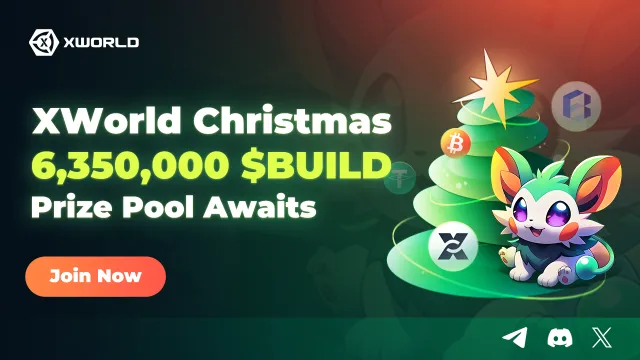
XWorld Christmas Event: 6,350,000 $BUILD Prize Pool Awaits!
XWorld brings cheer this Christmas! Inspired by the magic of the season, join us to celebrate, connect, and create unforgettable moments together!
📅 Event Duration
December 10, 2024 - December 30, 2024
🎁 Reward 1: Social King for Telegram
We’ll select the Top 10 most active users in the Telegram community to win:
🥇 1st: 30 USDT
🥈 2nd: 20 USDT
🥉 3rd: 15 USDT
4th-10th: 5 USDT each
🎁 Reward 2: Social King for Discord
Top 5 active users in the Discord community will win: Social King title + 10,000 $BUILD each 👑
🎁 Reward 3: Telegram Random Draw
Complete interactive tasks to enter the Telegram random draw. 20 lucky users will win 20 $WORLD each! 🎉
🎁 Reward 4: 5,000,000 $BUILD Prize Pool
Telegram Channel reaches 35,000 subscribers: 1,000,000 $BUILD of giftcodes shared with 10,000 people
Telegram Channel reaches 40,000 subscribers: 1,500,000 $BUILD of giftcodes shared with 2,000 people
Telegram Channel reaches 50,000 subscribers: 2,500,000 $BUILD of giftcodes shared with 1,000 people
📝 How to Participate in Tasks:
✅ Daily Check-ins: Send gm in our community #off-topic channel to check in.
✅ Subscribe to Telegram Channel (enable notifications for hidden gift codes).
✅ Visit MiniAPP
✅ Level Up Your Pet to Level 10
✅ Follow Official Twitter
✅ Join Telegram Group
✅ Join Discord Server
✅ Share Event Link and invite friends to join!
✅ Spread Christmas Cheer: Send Happy Christmas in our community #activity-zone channel.
⚠️ Important Notes:
Social King rewards for Telegram and Discord are mutually exclusive.
Telegram Random Draw winners and Social King winners cannot be the same. Alternate winners will be chosen if needed.
No cheating: Spamming, fake accounts, or manipulation will lead to disqualification. 🚫
Winners must complete all interactive tasks. If not, their rewards will be revoked. Winners will be announced within 3 working days, and rewards will be distributed within 7 working days.
X-WORLD reserves the final interpretation of the event rule.
Complete Guide to Earning Free Crypto in 2023
The last couple of years have marked an increase in the overall public awareness of cryptocurrencies worldwide. In return, a larger number of people have expressed their interest in purchasing or earning digital currencies.
While buying your favorite coin via an exchange is likely the easiest way to enter the cryptocurrency market, this industry is full of surprises — therefore a noticeable amount of coin can be earned for free.
As such, this article offered by XWORLD will cover the main methods that can be leveraged in order to obtain free crypto. Do keep in mind that most of these methods require a bit of effort, since nothing is ever truly free. However, these methods do not entail having to work a fulltime job, nor do they imply any monetary investment from your part.
Free Crypto from Coinbase Earn
Coinbase is largely seen as one of the most popular digital currency exchanges, especially in the United States.
While the platform facilitates the purchase and sale of crypto, it also offers its users the opportunity to earn several coins, including but not limited to Orchid, Tezos, Dai, EOS, Stellar, Zcash, Basic Attention Token and Ox.
For example, at the moment you can earn the following cryptos for free:
Orchid: users can earn up to $52 OXT by completing a free course meant to teach you the basics of this privacy-focused coin;
Tezos: completing a course on Tezos and learning about its openness, safety or upgradability will earn you $6 XTZ;
Dai: a similar course-based offer is available for Dai as well, thus granting course participants $20 DAI;
EOS: you can earn up to $50 EOS by completing a course on this coin, and learning more about its goal of facilitating the development of blockchain-based apps;
Stellar Lumens: the completion of a quick course on how Stellar connects payment systems, banks and individuals will earn you $50 XLM;
Zcash: this coin is known for its privacy-focused philosophy — course completion will grant you an undisclosed amount of ZEC tokens;
Basic Attention Token: $8-worth of BAT can be earned by reading on BAT’s vision of fixing the web;
0x: last but not least, educating yourself on OX’s token-based idea of the future web will award you several ZRX tokens.
Do keep in mind that there is a catch to these courses. You must be the holder of a Coinbase exchange account, where all tokens will be credited.
Earning Free Crypto via Airdrops
Airdrops are one of the simplest and most effective methods of earning extra cryptocurrency, especially in the form of newly-announced tokens. The idea behind airdrops is quite simple — innovative and newly-launched projects choose to hold airdrops as an effective marketing strategy, meant to pique the interest of the cryptocurrency community.
Participating in an airdrop is bound to be quite simple. It entails owning an active Ethereum wallet that is ERC-20 compatible, an email address, Telegram account, and in some cases, a Twitter account.
Once these criteria are met, you will have to look for Initial Coin Offerings (ICOs), Security Token Offerings (STOs), and token-based start-ups that have announced an upcoming airdrop.
Most of these platforms will require you to sign-up, by entering your ERC-20 address and email.
For marketing purposes, some airdrops may require you to follow them on Twitter, or join the Telegram chat group. This ensures that you’re kept in the loop and quickly become aware of news concerning the token.
Recently, KYC&AML regulations have made it mandatory for numerous airdrops to request identifying details. This is due to the money laundering potential associated with these events. Therefore, if you’re keen on protecting your online privacy, airdrops might not be the best choice for you.
Recently, numerous wallet providers such as Blockchain.com have started sponsoring airdrops.
In other words, you are announced whenever a partner start-up is holding an airdrop of their new tokens, and can earn the tokens directly in your wallet. Similarly, there are numerous websites which scour the web looking for new airdrop events. Following will help ensure that you will be one of the first people to know about upcoming airdrops.
Leveraging Bounties for Free Coin
Bounties are quite similar to airdrops, in the sense that they represent free coins given away by crypto project developers. There’s one key difference, however — bounties generally imply that you do some type of work in exchange for the coin.
With this in mind, here are the main types of bounties, alongside a quick description for each:
Bug bounties
Bug bounty campaigns are generally well-paid, yet they are only relevant to people who hold development skills. Programmers throughout the world actively attempt to crack the code of online platforms, while also testing for potential bugs.
As such, crypto and blockchain-based companies may hold bounty campaigns, where developers analyse platform functionality and report any bugs.
Over the last couple of years, there have been numerous instances in which white-hat hackers discovered vulnerabilities or significant bugs in web platforms. In return for this service, and based on the severity of the vulnerability discovered, companies can offer tens of thousands of dollars as compensation.
Signature campaigns
This marketing strategy is often implemented on forums such as Bitcointalk. In exchange for a monthly bounty, forum users add a specific signature, thus indirectly promoting the products and services of a crypto company.
Most businesses holding signature campaigns require forum users to have a higher membership level, which can be obtained through frequent high-quality posts. In return for buying the signature space, companies offer a monthly bounty in tokens.
Translations
Crypto start-ups are always interested in having their content translated into multiple languages. Since many start-ups run on a limited budget, a good method to go about this is to launch a translation bounty. Here, native users translate specific portions of text, in exchange for a number of tokens.
Social media, images, blog posts and video bounties
Last but not least, we also have other promotional bounties. Some companies may ask you to write and post a positive article on their services, whereas others may require you to edit videos, share posts on social media, or create promotional images.
Based on these aspects, bounties do, in fact, represent a method of earning free tokens, yet they imply actual work. Luckily, the work is generally quite easy (apart from bug bounties), and can be completed rather quickly.
Affiliate Marketing and Referrals
At this point in time, most experts define affiliate marketing as the process associated with promoting products and services of various companies, in exchange for a commission on each sale.
A recent research study concluded that US-based affiliate spending may reach $6.8 billion by the end of 2020.
As such, affiliate marketing represents a significant revenue stream for numerous companies, especially those which operate in the online ecosystem.
Therefore, it only makes sense that numerous crypto and blockchain-related businesses have launched their very own affiliate marketing campaigns. Getting involved is bound to be simple — in most instances, you need an account, and a personalized link, which can be shared across the web.
Any service or product that is purchased using your affiliate link or referral code will be credited with a percentage of the sale.
Affiliate marketing can earn you free cryptocurrency as long as you are active online. This implies sharing the link as part of valuable content on a variety of platforms, such as crypto discussion forums, Reddit, YouTube, Facebook, Twitter, Instagram, or your personal blog.
The possibilities are endless. Your success depends directly on the size of your audience and your overall online reach. However, this means that actual work needs to be carried out in order to get this free crypto. On the other hand, once your links are live, affiliate marketing becomes a lucrative source of passive income, which can be leveraged for a prolonged period of time.
To put things into perspective, here are several crypto-related affiliate campaigns:
Coinbase: if new users sign up using your personalized affiliate link, you are eligible to obtain 50% of the fees charged by the exchange platform for all transactions;
TREZOR: this platform offers 10% of net sales carried out by users who have signed up using your referral;
Ledger: this affiliate program promises to credit 12% — 15% of all sales;
LocalBitcoins: you can expect to earn 20% of the trading fee associated with each transaction that is carried out by referred users;
Binance: this exchange platform offers 20%-40% commissions on transaction fees.
Do keep in mind the fact that these conditions may be modified unilaterally by the website. Therefore, it is always recommended that you carry out your due diligence, and carefully research the affiliate marketing conditions associated with each of the examples given above.
Additionally, note that this list isn’t exhaustive — in fact, there are hundreds of crypto-related affiliate opportunities on the market at this moment.
It certainly isn’t unusual for affiliate marketing to become a main income stream, especially if done right. People have reported earning hundreds of thousands of dollars monthly using affiliate marketing strategies.
Given the fact that we are referring to the digital currency market, your income potential is further increased by crypto price volatility.
However, this entails that you treat it as a fulltime job until enough of your links are published on the web.
Earn BTC/ETH/PEPE etc. in XWORLD
Play Games and Earn: In XWORLD, you have the opportunity to play any games you love and earn rewards in the form of token BUILD. Whether you enjoy action-packed adventures, strategic puzzles, or immersive simulations, there’s a game for everyone. The more you play, the more BUILD tokens you accumulate, bringing you one step closer to earning Bitcoin, ETH, or PEPE.
Complete Quests and Challenges: XWORLD offers a variety of quests and challenges that test your skills and reward your efforts. By successfully completing these quests, you can earn additional BUILD tokens. Engage in thrilling missions, solve mysteries, or conquer difficult obstacles to unlock valuable rewards. The harder the challenge, the greater the potential for earning Bitcoin, ETH, or PEPE.
Join PvP Competitions: Are you a competitive gamer? XWORLD provides exciting player-versus-player (PvP) competitions where you can showcase your skills and earn rewards. Participate in thrilling battles against other players, climb the leaderboards, and emerge victorious. As you progress in PvP, you’ll earn BUILD tokens, which can be invested in the dividend pool to earn Bitcoin, ETH, or PEPE.
Invest in the Dividend Pool: XWORLD offers a unique opportunity to invest your earned BUILD tokens in the dividend pool. By contributing to the pool, you become eligible to receive a share of the dividends, which include Bitcoin, ETH, or PEPE. The more BUILD tokens you invest, the higher your potential earnings. It’s a smart way to grow your cryptocurrency portfolio while enjoying the immersive gaming experience XWORLD has to offer.
Reap the Rewards: As you accumulate BUILD tokens and invest in the dividend pool, you’ll start reaping the rewards in the form of Bitcoin, ETH, or PEPE. Watch your cryptocurrency holdings grow as you continue to engage with XWORLD’s games, quests, and PvP competitions. It’s an exciting and rewarding journey where your passion for gaming can translate into tangible digital assets.
Keep an Eye Out for Scams
Over the last couple of years, the popularity of the cryptocurrency market has increased exponentially. The rise in public awareness was mostly fuelled by intense volatility, and record-breaking prices.
With this in mind, the market is still seen as a way to get rich quickly. While there is significant money-making potential in crypto, this perception has led to the appearance of numerous scams, meant to fraud people out of their money.
Whenever dealing in crypto, there are two aspects worth keeping in mind: if an offer sounds too good to be true, it probably is. Also, you should never risk more than you can afford to lose.
Cybersecurity practices dictate that it’s best to always carry out in-depth research on any platform or service that you decide to use. Similarly, you should never give out your personal details or private keys to third parties.
Protection against scams and other forms of fraudulent activity is basically non-existent, whereas transactions are irreversible, therefore due diligence is essential.
Remember, XWORLD is not just a gaming platform; it’s a gateway to earning valuable cryptocurrencies. So, jump into the world of XWORLD, play your favorite games, complete quests, join PvP battles, earn BUILD tokens, and invest wisely to unlock the potential of earning Bitcoin, ETH, or PEPE. Start your journey today and experience the thrill of earning crypto while doing what you love.
Testnet has been launched in Southeast Asia.
Download: https://play.google.com/store/apps/details?id=pro.xworld.app
Join the XWORLD Community
Ready to explore the limitless possibilities of XWORLD? Visit the official website, follow XWORLD on Twitter (@xworld_pro) to stay updated on the latest news, releases, and opportunities. Don’t miss out on this exciting revolution in gaming and beyond!
Join our community for more:
Website | Twitter | Instagram | Facebook |Litepaper
Enjoy Your Passionate Game Time, Every Second Becomes Your Income.